Showing posts with label walking. Show all posts

Saturday, April 27, 2013

Westlake: Canberra's Ghost Suburb

Westlake's ghostly gums
This week, I have been thinking a lot about the past. On Monday morning, I had the opportunity to hear Scottish archaeologist, Neil Oliver, open the History Teachers Association of Australia annual conference. In his lovely lilting Scottish accent, he encouraged teachers to help their students make personal connections to the past, to encourage them to view past events as being part of their own lives, things that echo through the generations. [You can listen to his public lecture at the National Library here.]

As this week also marked the 98th commemoration of the landing at Gallipoli, with it's documentaries and live broadcasts, it wasn't difficult to remember that the past is always shadowing the present.

On ANZAC Day, we decided to go for a walk into Canberra's past, in the forgotten suburb of Westlake. I've lived in this city for 30 years now and until a couple of weeks ago, I couldn't have told you where Westlake was. A chance taxi ride gave me the opportunity to spot a sign on a bend in Empire Circuit and my colleague, Fiona, mentioned that a stroll through Westlake was interesting.

The roadside sign for Westlake
Westlake was a campsite that grew into a suburb as a result of the growth of Canberra. Workers came and set up their tents, some built cottages for their families, all probably dreaming of creating new lives for themselves in this still to be imagined city. And it turns out to be a fitting place to spend ANZAC Day. Paul Daley, in his book Canberra (New South Books, 2012), notes that many of the workers who came to help build the city were veterans of the First World War. There must have been times when, in the dry, dusty summers and the freezing Canberra winters, they wondered what on earth they had been fighting for.

Today, almost nothing remains of the suburb's physical inhabitants, although the 'children of Westlake' have erected small bronze plaques to commemorate their childhoods. It's a loving attempt to remind the city's current and future residents that the place now called Stirling Park was once home to 700 people. There's a small display of faded photographs as you enter the suburb and if you look around you as you walk, you can spot plaques noting the location of cottages and humpies and reminding us of the names of people who lived there: Bell, Belchamber, Ghiradello, Haines, Austin, Campbell, Day, O'Rourke.
The plaques at the entrance to Westlake
Daley notes that by the 1960s all of the buildings in Westlake had been demolished and half the suburb was submerged when Lake Burley Griffin was finally filled. Today, the only building left on the site is the sewer tower, a pungent reminder of the suburb's previous occupants.

Westlake's sewer tower
When I moved in 1982 from Sydney to Canberra, my teenage self railed against my new city's newness. Where were the historic buildings, the remnants of the colonial past? I soon discovered Blundell's Cottage, Lanyon and eventually Calthorpe's House, all three historic buildings turned into museums. But I was missing, I think, the living past - the streets of downtrodden terrace houses, the Rocks alive with history and commerce, the suburbs celebrating their colonial roots (Parramatta, Windsor). All I could see were smart new suburbs.

I'm not sure that in the intervening years Canberra has become any better at honouring it's heritage, black or white, even in this centenary year. We are good at layering the new on top of the no-longer-needed - who now remembers where Monaro Mall or the old Canberra Hotel used to stand? But in reading around to write this post, I've unearthed a number of people who are trying to remember the past and to share the stories of this city.

If you'd like to know more about Westlake, you can go for a stroll, read Paul Daley's Canberra, or explore some of the online histories, such as Dave's ACT and Hidden Canberra.

Saturday, April 6, 2013

Feeling the Serenity - Canberra's Corks

Canberra's wood of Cork Oaks on Good Friday, 2013
I've known about Canberra's wood of cork oaks for years. I've driven past it many times as I've turned west off the Tuggeranong Parkway and headed to Belconnen. I know people who have camped overnight on the edge of the wood. But until Good Friday, I'd never actually taken been there myself. I couldn't quite work out how to get there. With the National Arboretum now making the cork oak wood very accessible, there is no excuse not to explore.

So on Good Friday, we went for a beautiful, gentle walk amongst the cork oaks and had a small history lesson in the process. The wood is more of a glade, with the trees well spaced and the sun glinting through the canopy. The ground underfoot is soft, covered with lots of layers of leaves, and relatively flat. It's easy walking but you do have to watch out for the odd well-hidden branch and be prepared to climb a stile to get in and out of the wood. The walking path is well signposted and there are occasional park benches for resting and enjoying the view (including the occasional car whipping along William Slim Drive).

The stile leading into and out of the wood
The cork oaks are a living link to the very earliest days of the establishment of the city. The acorns for many of these trees were imported from Spain in 1917 by Walter Burley Griffin. Griffin's imagining of the city that we live in included a vision of its sustainability. He thought a plantation of cork oaks would be of real commercial value to the city. The plantation now includes over 4500 trees, although it didn't feel like that many when we were walking amongst them. We hunted for a few acorns of our own and this weekend we'll plant them and see what happens.

Hunting for acorns amongst the fallen leaves
The cork is harvested by ACT Forests so I guess the trees are contributing to the realisation of Griffin's vision. Harvesting commenced way back in 1948 in a small part of the plantation and you can tell which trees have had their outer layer of bark removed by their black lower trunks.

The cork oaks are heritage listed and are, I think, one of Canberra's secrets. If you'd like to 'feel the serenity' without going too far out of the city or the suburbs, the National Arboretum and it's glade of cork oaks is a good place to go. And if you'd like to find out more about the trees, the National Arboretum has published an informative essay by Susan Parsons on its website.

Thursday, October 4, 2012

Two Days in Paris

We have spent our first two days in Paris walking, trying to imprint the city on our brains through our feet. It's working. I think. Although when we come back in November, we will be in a completely different part of the city and may well have to begin again.

Yesterday, we walked without direction in the streets around our hotel. Hotel Aida Opera is a few streets back from Boulevard Montmartre with it's crazy traffic and chain stores. It is, though, home to two of Paris' oldest arcades, Passages Jouffroy and Passages des Panoramas (the oldest arcade in Paris). Passages Jouffroy is a delight, home to a number of antiquarian bookshops and a shop of minatures, offering everything a dollshouse needs, Tintin and Asterix figurines and merchandise that made Miles' heart sing. It is on the list for return visits, but after we've been to the Herge Museum in Brussels.
Passages Jouffroy
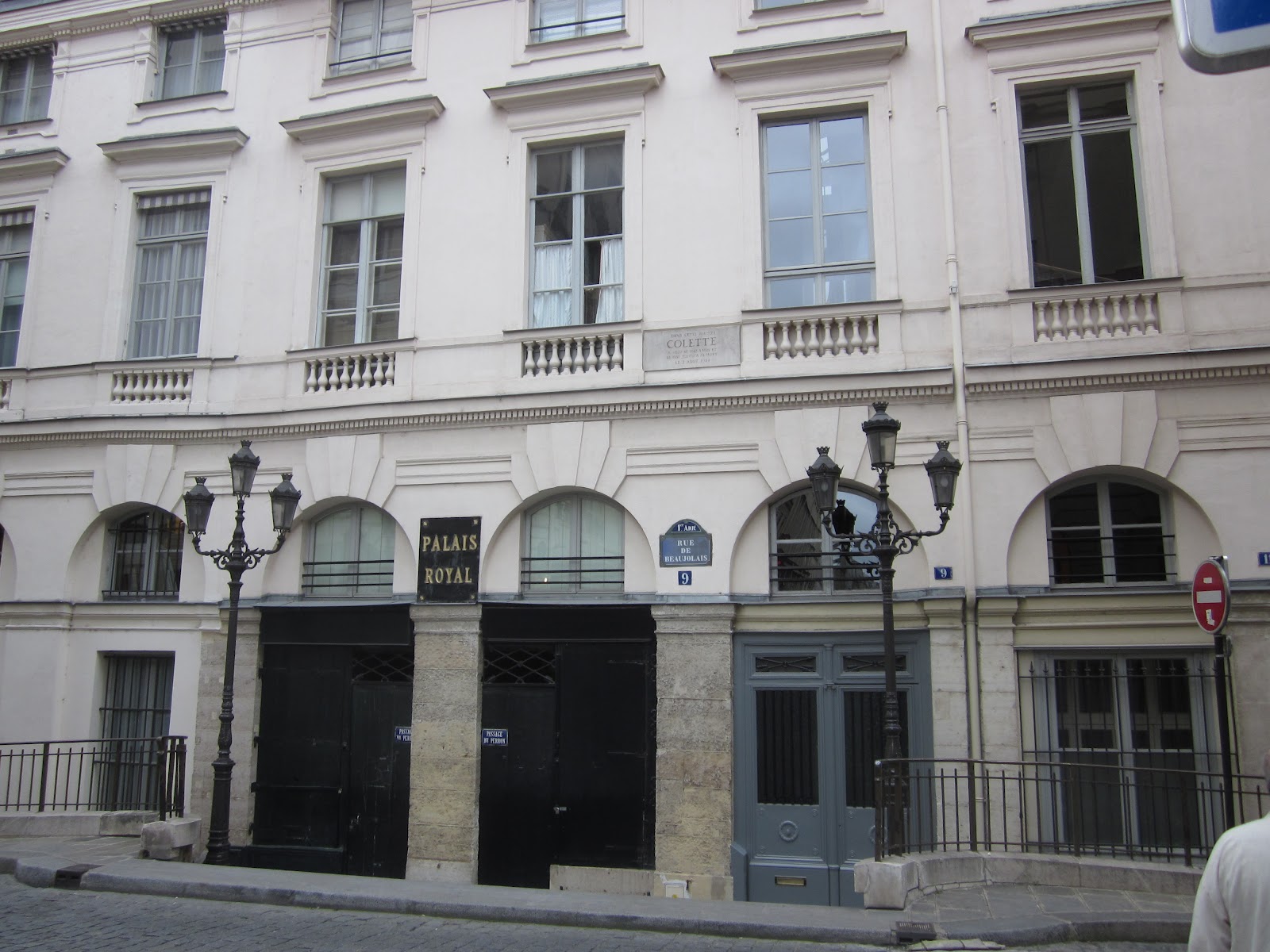
Today, we set out from the hotel to follow the tourist trail and discovered an uncanny ability to approach buildings from their rear. Perhaps we are backdoor people at heart. Palais Brongniart - back door. Bibliotheque Nationale - back door. Palais Royal and its gardens - back door. Comedie Francaise - back door. Even the Louvre - back door.

The rear of the Bibliotheque Nationale

And the rear of the Palais Royal - with a plague marking Colette's residence.
Miles' one request for the day was to visit the Eiffel Tower and so we did, hopping on a Batobus for a loop around the Seine. Luckily for Jim and I, the top floor of the tower was closed and, with showers looming, we convinced Miles to wait to climb the tower on a day when the views might be better. Miles is determined to get me to the top ... and I am equally determined to go no higher than the second viewing platform, which will be quite high enough. But we began our quest to ride all the carousels in Paris, discovering our first at the foot of the Eiffel Tower.

The carousel at the Eiffel Tower - a magnificent two-storey merry-go-round.
I also succeeded in falling for a gypsy scam - about five minutes after warning Jim to be on the lookout for pickpockets. I'm an idiot, what can I say? But my tip for the day - when a gypsy asks you if you speak English, say 'non'. Otherwise you might find yourself donating a few euros to save deaf and mute children living ... somewhere.