Showing posts with label Isabel Dalhousie. Show all posts

Saturday, January 6, 2018

(Thirty) Six Degrees of Separation

It's 36 degrees Celsius in Canberra at the moment. Rather than standing in front of the open freezer door, I'm thinking about different degrees ... of separation. I'm sure you know that Annabel Smith and Emma Chapman began the 6 Degrees of Separation meme in 2014 and now it is managed (is that the right word?) by Kate at Books are my favourite and best. The idea is that Kate nominates a book and, on the first Saturday of the month, participants reveal chains of six books that all connect in some way. If you are curious to see where other people's reading leads them, Kate's blog is a good place to begin. But I owe my introduction to Whispering Gums, another very good place to start.

The year begins with Alexander McCall Smith's The No 1 Ladies Detective Agency. Now, I haven't read any of the books in this series, despite the fame and love showered on its heroine, Precious Ramotswe (could she have a more delightful name?). But over 10 years ago, a dear friend gave me the first two books in what is now called the Isabel Dalhousie series, The Sunday Philosophy Club and Friends, Lovers, Chocolate. Set in Edinburgh, Isabel is an independently wealthy philosopher, the editor of a small magazine, who solves problems for friends and strangers. I'm delighted to see the 12th in the series will be published this year. I'm still reading along.

Next up could be a series (Harry Potter is too obvious, right?), a female detective (perhaps Aimee Leduc?), or a book set in Edinburgh (Ian Rankin?). But thinking about philosophy reminds me of Sophie's World: A novel about the history of philosophy. Written by Jostein Gaarder, this was a publishing phenomenon in 2007. I bought it hoping it would provide me with a quick guide to Philosophy. Perhaps I read it too quickly - none of it has stuck.

Jostein Gaarder is Norwegian and, as I'm starting to melt sitting here at the computer, I think we need to be somewhere cold for a few moments. Jo Nesbo is Gaarder's compatriot but his crime novels featuring Harry Hole (another detective, another series) have become a different kind of publishing phenomenon. The first in the Harry Hole series, The Snowman, is the only one I have read - although there is another on my TBR pile. I think I could become quite fond of Harry.

Let's keep with the 'snow' theme. Do you remember reading Snow Falling on Cedars by David Guterson? I can't quite believe it was published in 1994! I'd forgotten that it, too, is a murder mystery but I have a very strong memory of its depiction of anti-Japanese sentiments on the west coast of the United States in the 1950s. Much of the story is told in flashback and, if my memory serves me correctly, the novel also depicts Japanese Americans being interned during the war.

Internment takes me to my next book - I'm thinking of Always Afternoon (1981), a novel by Gwen Kelly, set in Australia during World War 1. Internment stories intrigue me. My grandfather was a chaplain at the Hay Internment Camp during World War 2. A beautiful television adaptation of the novel lead me to the book, which tells the story of German internees living in Trial Bay, NSW, during the war. Kelly published five novels, many short stories, and was awarded four Henry Lawson prose awards. You can read a little bit about her here.

I'm a bit stuck for where to end, partly because I'm thinking about the book I have been reading this afternoon, George Saunder's Lincoln in the Bardo. Maybe it's a bit of a cheat, but being interned is a little like being stuck in the 'bardo', that no-man's land between life and death. And both books are set during ugly, horrific wars. I'm so close to the end of the Lincoln in the Bardo, that there's only one thing left to do: go and finish it, while standing in front of the open freezer.

Wishing you many great and cool reads in 2018.


Thursday, October 25, 2012

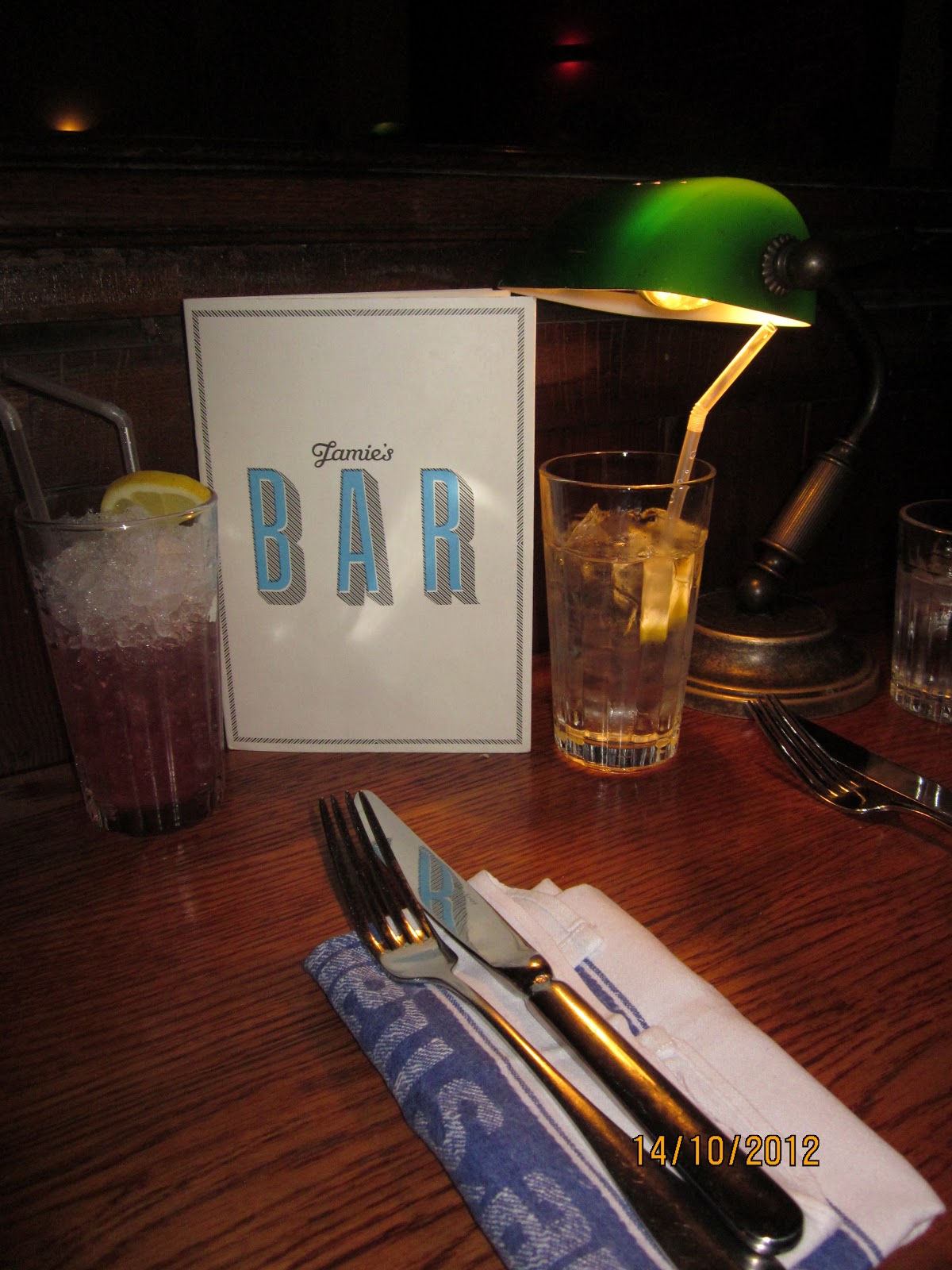
Dinner at Jamie’s or How I Missed the Cheltenham Literary Festival

Sunday evening. Our attempts to find accommodation at Gloucester (after first humming the Harry Potter theme in the Cathedral cloisters) had failed. In some English towns, finding even the town centre is like working your way through a maze. So we drove onwards, ever onwards, looking for the next town.

A winding country road, hedgerows, failing light, and then the sign ‘Cheltenham 6 miles’. I knew the Literary Festival was closing that night. I’d deliberately avoided Cheltenham for that reason. Too crowded and what would Jim and Miles do while I queued to listen to Ian McEwan, Ian Rankin, Alexander McCall-Smith, Nigella Lawson, David Walliams … who wasn’t going to be at the festival? But we were tired, it was getting dark, so we took the turn in the road and found ourselves at the Queens Hotel.

Across the road, the festival tents glowed white in the twilight. The festival bookshop, run by Waterstones, was in full swing and a queue was starting to form for one of the final sessions. And I didn’t have a ticket!

Instead, we went looking for dinner. A long walk through a dark town centre - always a pedestrian mall. A man in his sleeping bag in the Debenhams doorway. A Pizza Hut with teenagers queuing. Miles and I both tired, hungry and a little dispirited. And then, around a corner … Jamie’s Italian. Suddenly, the evening took a turn for the better.


We were lead up a winding staircase to the court room of the old County Courthouse. We were ushered into the Press Box, seated in a row, looking across at other diners seated at the Judge’s table. A children’s menu for Miles - with pencils. Menus for Jim and I. Drinks order taken. 


Our Albanian waiter ran through the menu -  no lamb, no bream, no fritto misto, and no pork belly advertised on the chalkboard on the street. But they still had pasta and the other special of the day, pumpkin risotto.

Jim was thinking of leaving. Thinking very loudly of  leaving. We'd eaten a lot of Italian lately - how much pasta can a man take? I was in no mood to leave - too tired, too hungry, and determined to have a ‘Jamie’ experience. Miles was just happy to have spag bol (again). So we stayed. Jim ordered ‘Funky Chips’ - here’s what he got.


The waiter was embarrassed - embarrassed that so many things were off the menu. He sent the manager to have a chat with us. He wasn’t at all embarrassed and couldn’t rustle up a single serve of lamb, pork belly or fish. He was grumpy and probably a little fed up - it was, after all, the end of the festival. What did we expect?

We soldiered on. We laughed (slightly hysterically). The chips were ‘funky’(doused in garlic) - and definitely a ‘side’. The risotto, though, was delicious and Miles begged for a second helping of the spag bol.

And our Albanian waiter proved to be an angel - he was so embarrassed, he convinced the manager to charge us for our drinks only, turning a potentially awful evening into a highlight of the trip.

As for the Literary Festival, this is what I saw on Monday morning.


But I did buy a signed copy of Alexander McCall Smith’s new Isabel Dalhousie novel from Waterstone’s, a momento of the festival I missed.

Sunday, September 26, 2010

The Charming Quirks of Others - Alexander McCall Smith

The Charming Quirks of Others is the seventh novel in the Isabel Dalhousie series, a series which is also known as the Sunday Philosophy Club series, although I don't think the Sunday Philosophy Club ever really existed. I should probably declare my hand early - I love this series. I haven't read any other books by McCall Smith, not even the first para of the acclaimed No 1 Ladies' Detective Agency series. And I don't think I want to, not at the moment anyway. But I do adore Isabel Dalhousie, even when she's driving me crazy.

The Sunday Philosophy Club came into my life accidentally. Three years ago, a friend sent me the first two books - The Sunday Philosophy Club and Friends, Lovers, Chocolates - when I was facing a long period of illness. They proved to be the perfect antidote - gentle, thoughtful, philosophical, humourous, engaging and slightly romantic. They are also set in Edinburgh, a city I've had a long love affair with. It began with a short acquaintance during my first overseas trip and continued through the pages of novels, mostly Ian Rankin's Rebus series.

Rebus' Edinburgh, of course, is pretty gritty. It's the Edinburgh of pubs and pool halls, council estates that brush against historical sites, the crime scene and the morgue. Isabel Dalhousie's Edinburgh is far more genteel. Hers is the Edinburgh of concert halls and art galleries and, in this novel, of old schools and Sir Walter Scott's home, Abbotsford. But as in the Rebus novels, the past is never very far from the present and by page 3, Isabel is once again reflecting on the Stuarts.

There's always a bit of a mystery in Isabel's life - philosophically, she can't resist requests for help - but the mystery is really (I suspect) just the excuse, the technical framework on which to hang the story. This time around, Isabel is asked to look into a poison-pen letter.

I don't read Isabel Dalhousie books for the mystery, though. I read to revisit the deli run by Isabel's niece, Cat, where the coffee is always fresh and the Italian newspapers are delivered daily. I read for the gentle, surprising relationship that has developed between Isabel and Cat's former boyfriend, the beautiful Jamie. I read too for the housekeeper, Grace, who believes in the afterlife and goes to 'meetings' to contact the dead. And for the war between Isabel and the deliciously named Lettuce and Dove. Mostly, though, I read for the charm of the writing, for the sheer joy of reading this:
He shook his head. 'You're doing it again. Inventing things. Whole stories now. Making them up.'

She got to her feet. 'But that's what the world is all about, Jamie. Stories. Stories explain everything, bring everything together.'
Stories explain everything.